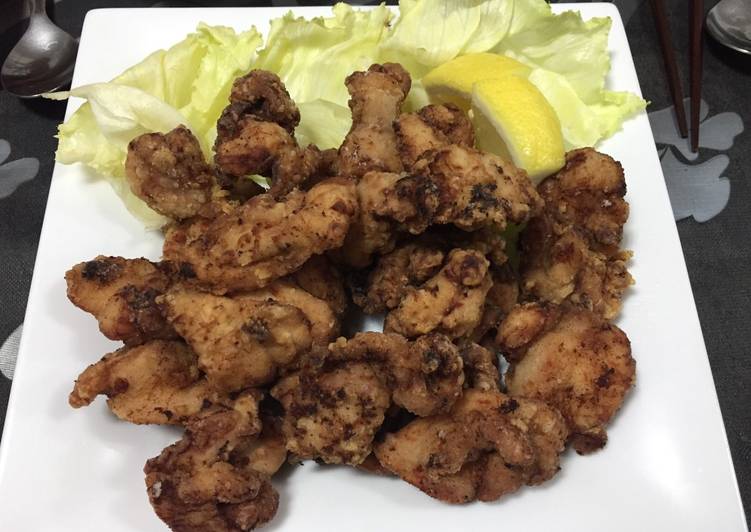
Hey everyone, it is Louise, welcome to our recipe site. Today, I’m gonna show you how to prepare a distinctive dish, japanese deep fried chicken (tatsuta age). It is one of my favorites food recipes. For mine, I will make it a bit tasty. This is gonna smell and look delicious.
TRADITIONAL JAPANESE RECIPE: To make Tatsutaage, the key ingredient is Katakuriko, the potato starch. The signature look of Tatsutaage is a white coating Tatsutaage is like Karaage, seasoned and deep-fried meat or fish. Remove a bit of the excess fat and born from Chicken.
Japanese Deep Fried Chicken (Tatsuta Age) is one of the most popular of recent trending foods on earth. It’s enjoyed by millions every day. It is simple, it’s quick, it tastes yummy. They are fine and they look fantastic. Japanese Deep Fried Chicken (Tatsuta Age) is something which I’ve loved my whole life.
To get started with this particular recipe, we must prepare a few ingredients. You can have japanese deep fried chicken (tatsuta age) using 7 ingredients and 6 steps. Here is how you can achieve it.
The ingredients needed to make Japanese Deep Fried Chicken (Tatsuta Age):
- Prepare 400 grams Chicken Thigh
- Get 2 tbsp Soy Sauce
- Get 1 tbsp Sake (Japanese Cooking Wine)
- Prepare 1 tbsp Mirin
- Get As needed Potato Starch
- Prepare As needed Lettuce
- Take As needed Lemon
When oil is hot, fry chicken until tender. Fry green pappers until just slft. You see, chicken in Japanese is toriniku (checken-meat) and so the full title of this dish should be: Toriniku Tatsuta-Age (Japanese Fried Chicken). Chicken tatsuta (チキン タツタ) is a Japanese-style fried chicken.
Instructions to make Japanese Deep Fried Chicken (Tatsuta Age):
- Remove a bit of the excess fat and born from Chicken. Poke holes on both sides with fork and cut into large bite size (20 - 30 grams/ piece).
- Mix the Soy sauce, Sake & Mirin in a bowl. Pour it on the Chicken, rub it in to marinate. Leave for 15 to 30 minutes and occasionally turn over. (If you want to freeze the chicken, you can do it then.)
- Wrap the chicken with paper towels and damp dry.
- Just before frying, coat the chicken with potato starch and dust off the excess powder. (Put the chicken & potato starch into a plastic bag. And shake it. You can make coat the chicken with potato starch easily.)
- Heat the frying oil 180 degrees, then put the chicken pieces in. Turn them over and fry till golden brown.
- Place the fried chicken on paper towels to soak the excess oil. Serve it with the lettuce on a dish. Squeeza the Lemon on the fried chicken and eat it.
Tatsuta-age indicates a way of cooking using deep frying. After marinating meat or fish, the meat is sprinkled with Japanese katakuri-ko (potato starch) before frying. Corn starch is also used if katakuriko is unavailable. Bite-size deep-fried chicken thigh is a standard Japanese izakaya/pub fare. These are super easy to make, and pairs really well with a glass of cold beer.
So that is going to wrap this up for this exceptional food japanese deep fried chicken (tatsuta age) recipe. Thanks so much for reading. I’m confident you will make this at home. There is gonna be more interesting food in home recipes coming up. Remember to save this page on your browser, and share it to your family, friends and colleague. Thank you for reading. Go on get cooking!